Trapped in Survival Mode? Here's What's Actually Happening
Summarized by VidSnap AI from The Holistic Psychologist on YouTube · Sep 14, 2026 · Watch the original
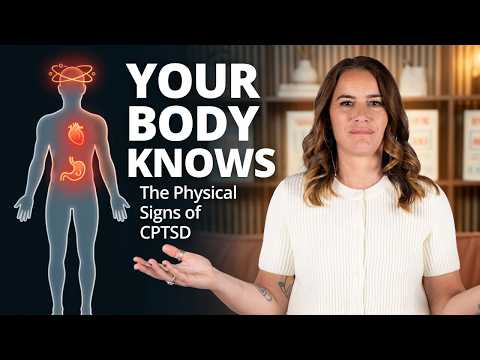
The Truth About CPTSD: Trauma, the Nervous System, and the Path to Healing
Dr. Nicole Laera, a holistic psychologist, presents this educational breakdown of why so many adults are living with undiagnosed Complex Post-Traumatic Stress Disorder (CPTSD). Rather than framing CPTSD as a list of abstract diagnostic criteria, she centers the conversation on the nervous system's survival adaptations — explaining that symptoms readers often label as anxiety, sensitivity, or personal failure are actually the body's learned, logical responses to chronic emotional trauma. The core message: understanding these patterns is the foundation for self-compassion and genuine healing.
📘 CPTSD vs. PTSD: What Is Actually Different
- PTSD commonly follows a single, identifiable traumatic event: a car accident, violent assault, war, or natural disaster.
- CPTSD, by contrast, emerges after repeated emotional trauma, prolonged stress, emotional neglect, emotionally unsafe environments, narcissistic family systems, abusive relationships, or years of childhood instability.
- Because this form of trauma happens gradually and becomes normalized, people often minimize it: "My childhood wasn't that bad," "My parents loved me," or "Other people had it worse."
In that sense, the reality of trauma cannot be reduced to isolated incidents:
"Trauma is not only about what happened to you. Trauma is also about what your nervous system had to repeatedly adapt to in order to survive."
This reframe is crucial—many people blame themselves for symptoms that actually represent the body's past attempts at protection. Trauma, as Dr. Laera emphasizes, is not only a cognitive memory; it is stored in the nervous system and the body.
🧠 The Body's Store of Past Danger
A key example illustrates this: after a serious car accident, the person feels anxious—yes like a normal response. But if years later they still avoid driving, panic around transportation, or emotionally relive fear inside the car, this shift enters the territory of CPTSD. The reason is that the body's "shore stress" continues to activate in moments that logically are no longer dangerous. Words like "I am safe" cannot force the nervous system into calm; the body simply feels the past's threat.
⚡ Major Signs of CPTSD
Dr. Laera outlines five major signs that help identify CPTSD in an adult day-to-day life.
1. Persistent Activation Around Perceived Danger
The body stays hyperactivated—on edge, unsettled—even while the thinking brain knows there is no physical threat. This chronic state can feel like fear that intensifies and a hypervigilant expectation that danger is "around every corner." The system's constant scanning uses the energy to be consumed and is a well of chronic emotional exhaustion.
2. Difficulty Regulating Emotions (Emotional Flooding)
After years of adapting to unpredictability, criticism, chaos, or emotional threat, the capacity to regulate emotion becomes compromised. People face:
- Panic, anger, irritability, overwhelm, or shutdown that appears suddenly and seems out of proportion.
- A simple suggestion ("Let's carpool") can trigger an intense responses in someone whose nervous system associates a car (or relationship) with danger.
- After the reaction, self-judgment is common: "Why did I react like that? What's wrong with me?" — a judgment often repeated by others who say, "It's not a big deal. Why are you so sensitive?"
These strong reactions are not character flaws; they are survival responses highly sensitized by a long history of unpredictability.
3. Dissociation: Dissonance From the Present
Dissociation is a protective mechanism that "checks out" when the present feels too overwhelming. There are many subtle manifestations:
-
Day-to-day: zoning out, feeling emotionally numb, losing the memory of facing time, feeling detached from oneself or others.
-
The familiar experience: driving a common route and realizing you remember nothing of the trip—the body drove "on autopilot."
-
In conflict: feeling numb, frozen, foggy, unable to speak, or emotionally reaching a million miles away while the argument continues.
Dissociation is so common in trauma because the nervous system learns a core rule:
"If I can't physically escape the overwhelm, I'll mentally escape."
Often, adults who have chronic overwhelm now feel like they are only "going through the motions" of life; full presence never felt safe before.
4. Physical Symptoms and Somatic Memory
Trauma has a known and physiological footprint. physical signs can include:
- Nausea, dizziness, shaking so much, a chest/tightness, panic attacks, or exhaustion.
- Strong/sensory triggers: certain spaces, sounds, or even smells (such as alcohol being smelled on a person) that reactivate past experiences and their body's stress response.
Because the bodily memory is so active, healing cannot be achieved through intellectual thinking (giving the idea logical, affirming "I'm safe"), the body must learn the experience of safety from within until intensity.
5. Avoidance and Emotional and Situational Triggers
Faced with overwhelm, the body will naturally try to keep resources safe. However, many people with CPTSD eventually build their whole lives around avoidance:
- Routine behaviors like driving, safe roads, conflict, closeness, or unknown situations become restricted.
- Avoidance makes sense in the short term: it reduces distress.
- But the effect is often the opposite, avoidance reinforces fear, whenever the nervous system doesn't get to learn that it survived, that the moment is not the same as the past, and they now have tools and resources.
🌱 Healing: Rebuilding Safety, Not "Just Getting Over It"
Regarding recovery, the key message is clear: healing is not about "forcerating yourself out of it," nor expecting yourself to simply "get over it." Instead, the goal is to rebuild safety incrementally inside the nervous system and body, teaching that what was once happening is no longer here.
The foundations Dr. Laera discusses are:
- Nervous system/spirit — flows like breathwork, sleep, proper movement, somatic or body-centered practices, mindfulness, and present-moment awareness.
- Nutrition and steady, healthy relationships as signals of support.
- Therapy — alongside professional support in educational settings, such as her private community "Self-Healer Circle".
Self-Compassion as a Turning Point
All of these practical tools are rooted in self-compassion. Many adults with CPTSD become deeply self-critical, judging their own emotional sensitivity, reactivity, or exhaustion.
But in her view, the survival themselves are not a sign of weakness—they are evidence of adaptation.
- Shame keeps people locked in the past; understanding and compassion open the way out.
- People who stop feeling "broken," but instead see a body that once worked heroically under impossible conditions, can stop punishing themselves and learn more gentle regulation.
- This shift is valuable in suddenly changing the why from "what's wrong with me" to:
"What happened to my nervous system?"
🔑 Key Takeaway
CPTSD is not a character flaw or a label for past mistakes; it a physiology in presence that the nervous system had to learn to survive repeated emotional danger. The main signs—hypervigilance, emotional flooding, dissociation, physical symptoms, and avoidance—all reflect a deeper message: this body was conditioned to expect threat. Healing, the person therefore, is about gradually teaching that threat that danger is no longer persistent by safe relationships, nervous system regulation, and self-awareness. With awareness, support, and self-presence, no one has to live permanently in survival mode—the path to lasting peace begins with compassion for the system that has been trying to protect you all along.
Want to summarize your own videos?
Try VidSnap free