Andrej Karpathy just changed how he prompts claude... (INSANE RESULTS!)
Summarized by VidSnap AI from Dream Labs AI on YouTube · Aug 8, 2026 · Watch the original
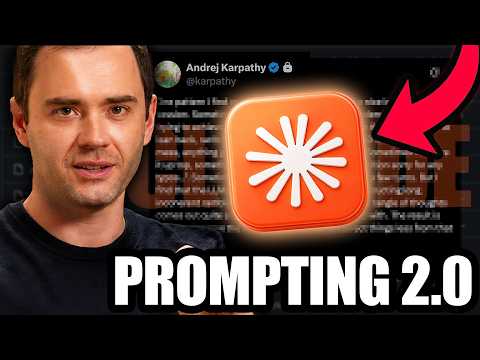
Andrej Karpathy's Prompting 2.0: A Paradigm Shift in AI Interaction
Introduction
Andrej Karpathy, a pioneering figure in modern AI and former Tesla AI director, has introduced a revolutionary approach to prompting AI models that has captured widespread attention with over 4 million views on his viral Twitter post. The video examines his "Prompting 2.0" technique, which fundamentally challenges conventional wisdom about AI interaction by advocating for prolonged, unfiltered voice rambling rather than concise, structured prompts. This approach leverages the enhanced capabilities of current AI models to process and reconstruct seemingly incoherent human thought patterns.
Core Concept Breakdown
Prompting 1.0 vs. Prompting 2.0
Prompting 1.0 represents traditional interaction methods: providing short, focused instructions (typically 1-3 minutes of input) and then iteratively correcting the AI's output through multiple rounds of feedback. This approach often requires multiple correction cycles and produces inferior final results.
Prompting 2.0 transforms the initial interaction into an extensive 10-minute stream-of-consciousness session where users verbally explore their entire project vision without structure or self-editing. This method requires more upfront time investment but dramatically reduces subsequent iterations.
Karpathy's Four Essential Steps
-
Declare the style upfront: Inform the AI you're switching to voice mode and will be stream-of-consciousness rambling (apologizing for potential typos, helping the AI calibrate its interpretation).
-
Switch to voice mode: Utilize tools like the microphone button in Claude Code, Whisper Flow, or similar voice-to-text software—the specific tool doesn't matter.
-
Lean back and relax: Physical posture affects cognitive state; reclining encourages the unfiltered rambling this technique requires.
-
Commit to the full 10 minutes: Most users only speak for 2-3 minutes; the magic emerges in pushing beyond comfort zones to access deeper project understanding.
This approach proves most valuable when starting new sessions or projects where comprehensive context establishment is crucial.
Key Takeaways & Outcome
-
Comparative Results: The Prompting 1.0 approach required 53 total minutes of back-and-forth interaction (multiple correction rounds of 12-18 minutes each) and produced a 7/10 outcome with technical, hard-to-interpret design.
-
Prompting 2.0 Efficiency: Despite the 10-minute initial investment, only one additional short edit round was needed, completing in roughly half the total project time.
-
Superior Output Quality: The Prompting 2.0 version delivered a more polished, interactive dashboard that better understood the user's intent and context.
-
Enhanced Insights: The AI unearthed valuable patterns and lessons from the data, including specific milestones and strategic recommendations the user hadn't explicitly requested.
"LLMs are somehow very good at reconstructing long incoherent rambles... their echo of your own tangle of thoughts comes out quite a bit cleaner than what you started with."
Key Takeaway
🎯 Most Important Insight: The core philosophy shift is that longer, "rambling" context upfront leads to better final outputs and fewer corrections. This method works because modern AI models excel at pattern recognition within unstructured thought, extracting meaningful structure that users themselves may not consciously recognize. The AI doesn't just follow instructions—it collaboratively structures your thinking, resulting in outputs that more accurately reflect your true vision while requiring substantially less iterative correction. This represents a fundamental evolution from treating AI as a command executor to engaging with it as a thinking partner.
Want to summarize your own videos?
Try VidSnap free