Apple's New Mac Line is Built Around Local AI. The Bet Is You'd Rather Own Than Rent.
Summarized by VidSnap AI from AI News & Strategy Daily | Nate B Jones on YouTube · Sep 3, 2026 · Watch the original
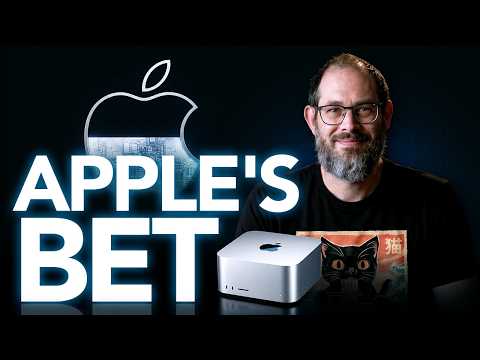
Apple’s Local AI Bet vs. The Cloud Frontier
This video from Nate B. Jones analyzes Apple’s recent desktop Mac refresh, which is explicitly designed around local AI compute. The launch features new M6 and M5 chip configurations with dramatically expanded unified memory, positioning the Mac as a device capable of running substantial AI models on-device. The analysis explores the strategic implications of this move against the competing trend of cloud-based frontier agents.
The New Product Lineup 🖥️
Apple has restructured its desktop line to offer a "ladder" of local AI capability:
- Mac mini (M6): 16–32 GB memory, positioned as an "always-on" machine for running modest local models and agents.
- Mac mini (M5 Pro): Up to 64 GB memory with nearly double the bandwidth, designed for more demanding local workloads.
- Mac Studio (M5 Max/Ultra): Ranges from 128 GB to a massive 512 GB with 1.2 TB/s bandwidth, aimed at running "really big language models" entirely on-device.
- Pricing: Starts at $2,500 for the M5 Max Studio and $5,500 for the M5 Ultra, with the top-tier 512 GB configuration arriving in late October.
Strategic Positioning & The Chip Wrinkle 🧠
A notable detail is that Apple placed the new M6 generation only at the bottom of the line, while the more powerful Mini and Studio models remain on the M5. Jones interprets this as a sign of urgency: Apple prioritized shipping the large memory configurations people need now, rather than waiting for a full chip family alignment. The strategy is not to compete with data centers for frontier model capacity, but to provide sufficient local compute for a significant share of everyday work, offering a fixed-cost alternative to per-token cloud billing.
The Local vs. Cloud Economics ⚖️
The core tension is between two futures:
- The Local Bet: Users own powerful hardware, run open-source models (like Gemma), and pay only for electricity. This appeals to prosumers who value privacy, control, and predictable costs.
- The Cloud Bet: Companies like OpenAI and xAI offer persistent cloud computers (e.g., Grok Bot, ChatGPT Work) that can run frontier agents, maintain life context, and work continuously. This model rents intelligence and convenience, with a recurring revenue advantage for the labs.
Market Outlook & The Missing Middle 📈
Jones argues the market is large enough for multiple winners. He estimates that 5–10% of the market will invest in local hardware despite technical hurdles, while the majority will default to cloud services. However, he identifies a "missing middle"—the lack of a seamless way to route tasks between local and cloud models. He notes that Hugging Face, recently acquired by Nvidia, is ironically best positioned to solve this local installation and routing problem.
Key Takeaway
The video concludes that the next 90–120 days will force serious AI users to choose where to invest. Jones predicts a "both/and" scenario: investing in powerful local Macs for 80–90% of intelligence work while relying on frontier labs for premier tasks. The ultimate winner will be the company that makes it easy to route work between the two.
Want to summarize your own videos?
Try VidSnap free