The ONLY AI Tech Stack You Need in 2026
Summarized by VidSnap AI from Cole Medin on YouTube · Nov 8, 2025 · Watch the original
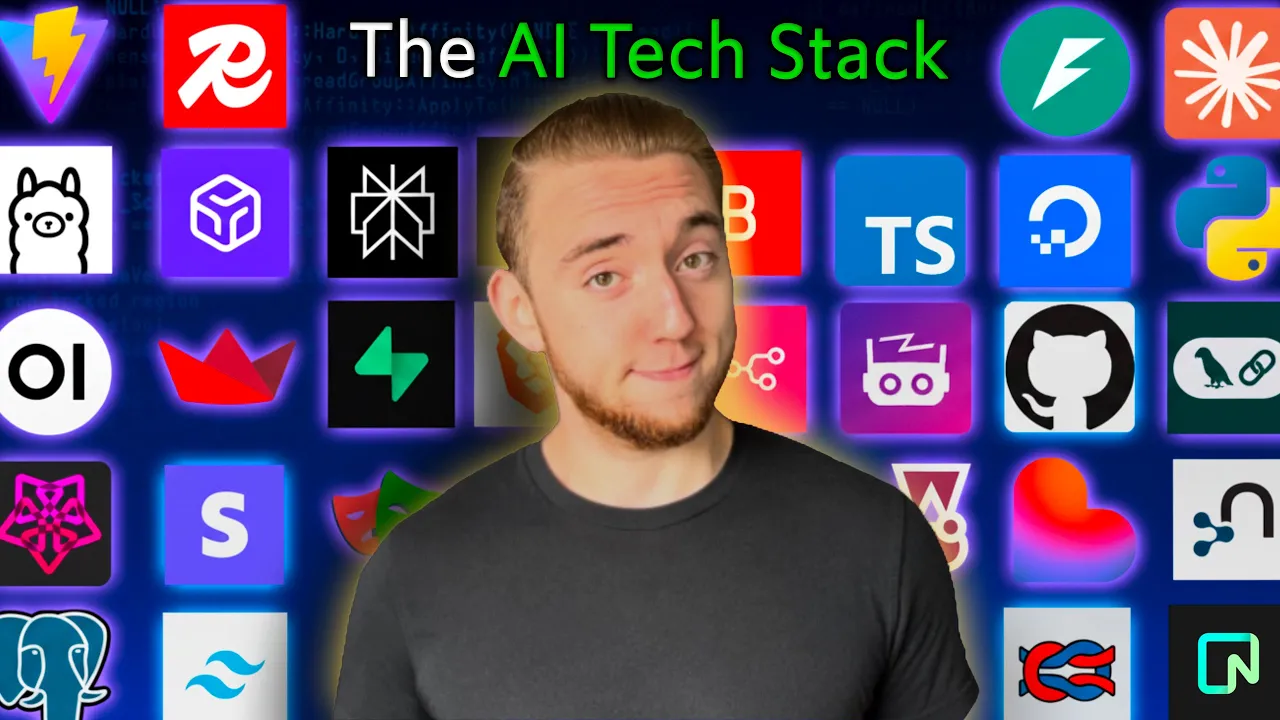
The "AI-first" tech stack for 2026 emphasizes stability and adaptability, prioritizing capabilities over specific tools. This scholarly overview covers core infrastructure, AI agent development, full-stack components, and deployment, alongside self-hosting.
Core Infrastructure:
- Database: PostgreSQL (Neon, Superbase) is the primary choice, standard for AI agents due to LLM compatibility and scalability.
- Caching: Redis provides blazing-fast performance, with Valkey as an open-source local option.
- AI Coding Assistant: Claude Code, often integrated with Archon for task management, is the daily driver, praised for its advanced features.
- No-Code Prototyping: N8N accelerates agent idea validation with its AI-focused integrations and self-hostable nature.
AI Agents (General):
- Frameworks: Pydantic AI builds individual agents, offering flexibility. LangGraph connects them into complex multi-agent workflows, excelling in state management and human-in-the-loop control.
- Authorization: Arcade is critical for secure agent authorization and tool access (e.g., Gmail, Slack), leveraging OAuth and an MCP server SDK for granular control.
- Observability: Langfuse monitors agent performance, costs, latency, and tool calls in production, essential for reliable operation and evaluation.
RAG Agents Specifics:
- Data Extraction: Dockling extracts data from complex files (PDFs, Excel), while Crawl4AI handles websites efficiently, often with LLM-driven cleaning.
- Storage: PostgreSQL with pgvector serves as a versatile vector database, integrating seamlessly with existing document data.
- Long-Term Memory: MemZero offers flexible integration with any database, enabling memory injection and extraction for agents.
- Knowledge Graphs: Neo4j is the preferred graph database engine for its UI, scalability, and broad support. Graffiti extracts entities and relationships from text for graph population and search.
- Evaluation: Regos specializes in RAG metrics (faithfulness, relevance) and automated test data generation, enhancing agent reliability.
- Web Search: Brave (fast, privacy-focused) and Perplexity (detailed) provide general web knowledge for agents.
Web Automation Agents:
- Live Data/Social: Crawl4AI extracts live web info; Ampify or Bright Data manage social platform interactions (LinkedIn, X).
- Browser Automation: Playwright is the deterministic automation king, supporting multi-browser control and AI coding assistant integration.
- Advanced Browser Control: Browserbase (Stagehand, Director) empowers agents to control browsers live with managed infrastructure, anti-bot detection, recorded sessions, and automation code generation.
Full Stack Development:
- APIs: FastAPI (Python) is chosen for AI agent backends; Express (TypeScript) is an alternative.
- Authentication: Superbase provides simple authentication, while Auth0 addresses enterprise-grade needs like MFA and SSO.
- Frontend: React with Vite creates snappy, lightweight UIs.
- Component/Styling: ShadCN UI and Tailwind CSS are standard choices.
- UI Builders: Lovable (agentic) or Bolt.diy (open-source) facilitate AI-driven UI creation. Streamlit is invaluable for rapid Python-based UI prototyping of agents.
- Monitoring/Analytics: Sentry offers real-time data and integrates AI features.
- Payments: Stripe is favored for its developer experience.
Deployment & Infrastructure:
- Platforms: Render provides simple, Infrastructure-as-Code deployments. Google Cloud is preferred for enterprise requirements, and Runpod for GPU-heavy, cost-effective cloud workloads.
- Virtual Machines: Digital Ocean offers reliable managed VMs, with Hostinger/Hetzner as affordable alternatives.
- Containerization: Docker is the industry standard for isolated and portable application environments.
- CI/CD: GitHub Actions automates workflows, integrated directly with repositories.
- Testing: Pytest (Python) and Jest (TypeScript) ensure code reliability.
- AI Code Review: Code Rabbit offers free, detailed AI reviews and security detection for open-source projects.
Local & Self-Hosting Options:
- Local LLM Chat: Open Web UI and Anything LLM offer local ChatGPT-like experiences.
- Local Web Search: CRXNG provides self-hosted web search.
- Local LLM Serving: Ollama simplifies serving local LLMs, with multi-GPU support and quantization options.
- HTTPS/TLS: Caddy is the simplest option for domain management.
Final Takeaway: The core recommendation is to establish a stable, adaptable tech stack aligned with specific needs, always prioritizing problem-solving and capabilities over tool mastery. This approach fosters efficient development of robust AI-first software.
Want to summarize your own videos?
Try VidSnap free